



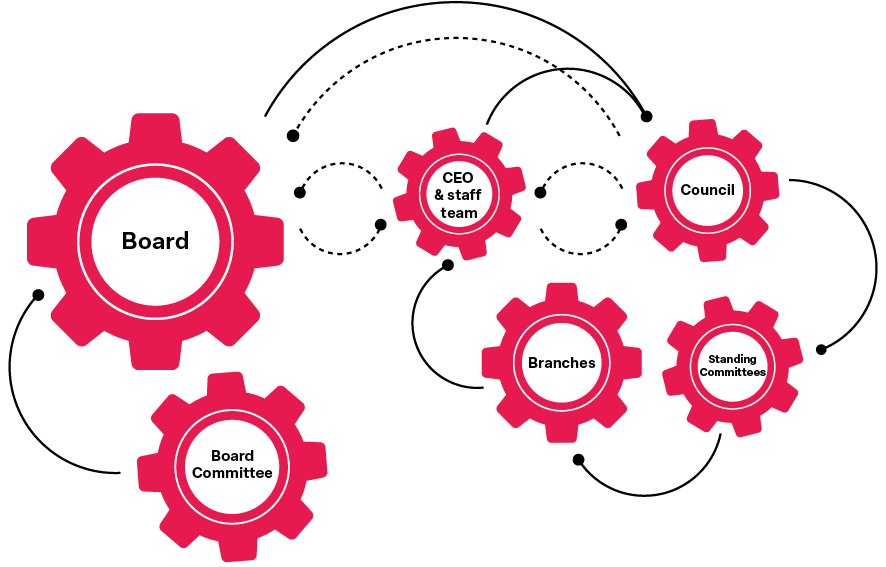
The LI has launched four new standing committees, putting members at the heart of the LIs work. These committees will shape the future of the profession and our external impact.
The four standing committees drive the LI’s work in important areas, collaborating to oversee and facilitate much of our member and external-facing work. Further information about the committees can be found below in the Terms of Reference, Role Descriptions and the FAQ.
The current members of each Standing Committee are as follows:
| Education & Careers (ECC) | Knowledge & Practice (KPC) | Membership & Professional Standards (MPSC) | Policy & Public Affairs (PPAC) |
| Promoting landscape careers and ensuring high standards in both traditional and alternative routes into the profession. | Overseeing technical guidance and ensuring industry best practice. | Safeguarding professional integrity and overseeing membership pathways and ethical standards. | Influencing government policy and building relationships with other organisations. |
| Emma McNamara (Chair) Jonathan Emery Kristoff Fatsar Rachel Cox Alistair Kratt Usue Ruiz-Arana Anna Rhodes Marko Yau Chung Ming Kenny Fraser Robyn Friesner | Graham Lee (Chair) Joe Robson Carly Tinkler Jon Rooney Lucy Elphick Jenkins Thomas Yunqing Bai Paul Reynolds Mirna Joanna Melki Michael Shilton Heather Simeonov | Mark Smeeden (Chair) Vanessa Ross Nick Harrison Lucy Marshall James Brisco Carol Ann Newell | Ian Phillips (Chair) Marc Tomes Annie Coombs Richard Copas Luke Engleback Ian Houlston Anastasia Nikologianni Richard Sumner Andrew Smith Chris Fairbrother Scarlett Towse Simon Bell |
Education & Careers Committee
The ECC plays a vital role in supporting the Institute’s work to promote the landscape profession as a career of choice, ensuring that traditional and alternative routes in to the profession meet the highest standards and are relevant, robust and adaptable to a fast-changing world. The committee supports the development and delivery of an education and careers strategy, and leads the LI’s strategic engagement with universities and academic partners, including the accreditation of courses.
Activities of the Education & Careers Committee
- Attract people to choose a career in the landscape profession, building a pipeline of people entering the profession.
- Identify ways to work with schools and colleges to encourage young people to pursue a career in the landscape profession.
- Ensure a range and variety of academic and other options for people entering the profession, working closely with academic partners, universities and others to create new opportunities.
- Develop and promote existing and new entry routes to the profession such as apprenticeships.
- Ensure that university courses are of high quality by leading the accreditation of approved courses.
Bio of Emma McNamara FLI (Chair)
Emma McNamara FLI is a heritage landscape leader specialising in the conservation and management of historic gardens and cultural landscapes. She spent 14 years at the National Trust in senior consultancy and leadership roles, shaping long-term conservation planning and serving as the national Horticulture Development Specialist – developing organisation wide training and education, early career pathways, apprenticeships, and skills programmes.
In addition, Emma has conducted extensive postgraduate research at Southampton University, exploring the application of GPS and GIS technologies in the management of public open spaces for tourism. Their research has contributed valuable insights into enhancing visitor experiences and improving tourism management within heritage landscapes.
Emma is currently a Director of MUSE delivering conservation planning, heritage impact work, and sector training and CPD, and a Regional Manager at WFGA, placing and supporting trainees in horticultural roles.
As Chair of the Landscape Institute’s Education & Careers Committee she is committed to strengthening clear, inclusive routes into the profession and championing learning, progression, and high standards across the landscape sector.
Answer your questions about the Standing Committees
Knowledge & Practice Committee
The role of the Knowledge & Practice committee is to inform and assist with development and dissemination of technical guidance and best practice on landscape issues, to inform the knowledge and practice of members and the wider profession. They also oversee the LI’s influence on technical landscape matters.
The committee promotes an evidence-based ethos within the landscape profession and members will ensure the full range of expert input is sought from across and beyond the membership to address and promote best practice, guiding and overseeing Task and Finish groups working on detailed issues.
Activities of the Knowledge & Practice Committee
- Identifying knowledge and practice priorities and make recommendations to the Board for their inclusion in the annual business plan.
- Commissioning and overseeing technical research, within agreed budgets, and its translation into evidence-based technical output.
- Engaging with branches, members, the Board and Advisory Council to gauge views and seek input to inform their choices and help manage priorities.
- Overseeing the creation of Tools, Guidance, Standards and Good Practice Principles to inform and support the objectives of the LI, ensuring approval by the Board where required.
- Fostering collaborative work by connecting with possible partners and stakeholders to help deliver objectives, and identify existing work the LI could take part in.
- Reviewing previous output or publications by the LI or others to improve it. Providing feedback on draft output from partners.
- Identifying and developing training to be delivered through the LI or externally, for example via Continuing Professional Development (CPD) provision, Workshops, Webinars, Talks, Conferences etc.
- Representing and reporting back to the LI on external committees, groups, events, media outlets, etc. as pre-agreed by the Panel and LI.
Bio of Graham Lee CMLI (Chair)
A Chartered Landscape Architect with 30 years’ experience across landscape planning, design, management and environmental assessment, working at the interface between research, policy and practice. He IS currently Head of Landscape Architecture, Green Infrastructure and Nature-based Solutions at Pell Frischmann Consultants Ltd, supporting the development and application of evidence-based approaches across multidisciplinary infrastructure and development projects.
Expertise includes many areas of the landscape profession including planning (LVIA), design, management, landscape-led master planning, technology (GIS), as well as green infrastructure and nature-based solutions, ecology and biodiversity net gain, and ecosystem services and natural capital.
He has extensive experience translating research, policy and technical guidance into practical tools, standards and good practice, including advisory roles for major infrastructure and development programmes, including those for National Highways, Natural England and Nationally Significant Infrastructure Projects / Development Consent Order contexts, where clarity, consistency and auditability of guidance is critical.
In addition, he is currently a guest critic for the University of Greenwich Landscape and Urban Design programmes and has been appointed as 3 Landscape Planning consultant advisor to the South Downs National Park for the next four years.
Membership & Professional Standards Committee
The MPSC plays a key role in driving high standards in the landscape profession, monitoring and ensuring compliance against the Institute’s professional standards. They provide strategic oversight to ensure a high-quality profession, and growing membership in inclusive and equitable ways.
This committee oversees the development of all routes to LI membership ensuring that the membership proposition is fit-for-purpose and monitored and communicated effectively. They assist the LI with member onboarding, standards for qualifying for chartership or other routes, and in providing a foundation for lifelong learning. They also make recommendations for the award of Fellowship.
Activities of the Membership & Professional Standards Committee
- Set and maintain high standards for the profession, including entry standards.
- Make sure that our membership value proposition for all grades of membership is robust, appropriate and up to date with the needs of the membership, making sure that membership is attractive to all those who meet the requirements.
- Promote a culture of lifelong learning in the profession by ensuring that we offer high quality continuing professional development opportunities.
- Attract more volunteers to support the Institute’s work, with a credible and attractive volunteering experience.
- Ensure that those pursuing chartership have the best possible experience, with effective support and development.
- Recognise high achievement in the profession by recommending people for fellowship.
Policy & Public Affairs Committee
The PPAC plays a vital role in maximising the LI’s impact on the world – influencing government policy and building relationships with other organisations to further our objectives.
The range of policies that relate to landscape, which affect LI members are significant as we seek to address the environmental crisis. The committee works with the staff team to identify priority policy areas and strategies to influence other organisations. They also achieve positive changes in government policy on behalf of the membership.
Activities of the Policy & Public Affairs Committee
- Identifying policy priorities and making recommendations to the Board for their inclusion in the annual business plan.
- Informing and supporting the formulation of policy positions, ensuring they represent member views.
- Informing and assisting with delivering public affairs strategies and political strategies for achieving LI objectives. This may involve:
- working with other LI Committees on public affairs issues which relate to their remit
- meeting decision makers and conveying policy asks and positions.
- informing, assisting in drafting and signing off letters to Ministers and responses to written policy consultations.
- engaging with the media to make the case for policy interventions.
- Working with staff in engaging branches, members, the Board and Council on policy and public affairs issues to gauge members’ views and seek their input to strengthen responses or messages.
- Championing the LI, its policy positions and landscape professionals at external events.